


Michael VII Doukas or Ducas (Greek: Μιχαήλ Δούκας, romanized: Mikhaḗl Doúkās), nicknamed Parapinakes (Greek: Παραπινάκης, romanized: Parapinákes, lit. 'minus a quarter', a reference to the devaluation of the Byzantine currency under his rule), was the senior Byzantine emperor from 1071 to 1078. He was known as incompetent as an emperor and reliant on court officials, especially of his finance minister Nikephoritzes, who increased taxation and luxury spending while not properly financing their army (which later mutinied). Under his reign, Bari was lost and his empire faced open revolt in the Balkans. Along with the advancing Seljuk Turks in the eastern front, Michael also had to contend with his mercenaries openly turning against the empire. Michael stepped down as emperor in 1078 and later retired to a monastery.
Life
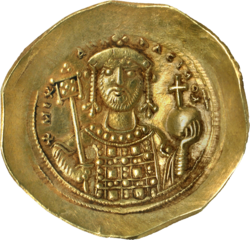
Michael VII was born c. 1050 in Constantinople, the eldest son of Constantine X Doukas and Eudokia Makrembolitissa.[1] He was probably associated with the throne by the end of 1060, together with or shortly before his newly born brother Konstantios Doukas.[2] When Constantine X died on 23 May 1067,[3] Michael VII was already 17 years old and should have been able to rule by himself. He exhibited little interest in politics, however, and his mother Eudokia and uncle John Doukas governed the empire as effective regents.[4]
On 1 January 1068, Eudokia married the general Romanos IV Diogenes, who now became senior co-emperor alongside Michael VII, Konstantios, and another brother, Andronikos.[5] When Romanos IV was defeated and captured by Alp Arslan of the Seljuk Turks at the Battle of Manzikert in August 1071,[6] Michael VII remained in the background, while the initiative to take power was taken by his uncle John Doukas and his tutor Michael Psellos.[7] Michael VII was proclaimed emperor on c. 1 October 1071, although Eudokia co-ruled with Michael VII for a month before being dispatched to a monastery.[α][β]
Although still advised by Michael Psellos and John Doukas, Michael VII became increasingly reliant on his finance minister Nikephoritzes.[9] The emperor's chief interests, shaped by Psellos, were in academic pursuits, and he allowed Nikephoritzes to increase both taxation and luxury spending without properly financing the army. As an emperor he was incompetent, often surrounded by sycophantic court officials.[1] In dire straits, imperial officials resorted to property confiscations and even expropriated some of the wealth of the church. The underpaid army tended to mutiny, and the Byzantines lost Bari, their last possession in Italy, to the Normans of Robert Guiscard in 1071.[7] Simultaneously, they faced a serious revolt under Georgi Voyteh in the Balkans, where they faced an attempt at the restoration of the Bulgarian state.[9] Although this revolt was suppressed by the general Nikephoros Bryennios,[9] the Byzantine Empire was unable to recover its losses in Asia Minor.
The product is a Byzantine Empire gold coin featuring Michael VII, minted between AD 1071-1078. It is certified by NGC and is uncleaned, making it a rare find for collectors interested in ancient Byzantine coins. This particular coin has a sense of urgency and excitement surrounding its ownership history, as it is being marketed as a scare item with a captivating story. Its historical significance and unique status within the Byzantine Empire make it a valuable and sought-after piece for numismatists.